Tour guide radio systems: how they work, what they cost, and the smartphone alternative

Anyone running guided tours, events or courses for groups knows the problem well: whoever is speaking needs to be heard clearly by everyone, even in noisy environments, outdoors, or when the group spreads out over several metres. For decades, the standard solution has been tour guide radio systems: a transmitter for the guide, receivers with an earpiece for every participant. They work, but they come with real logistical overhead.
In recent years, a lighter alternative has emerged: apps that stream audio directly to the group's own smartphones, with no extra hardware to rent, charge, or sanitise. In this article we look at how tour guide radio systems work, what they realistically cost, where they fall short, and when an app like VoiceGuide AirLink is the simpler choice.
What tour guide radio systems are and how they work
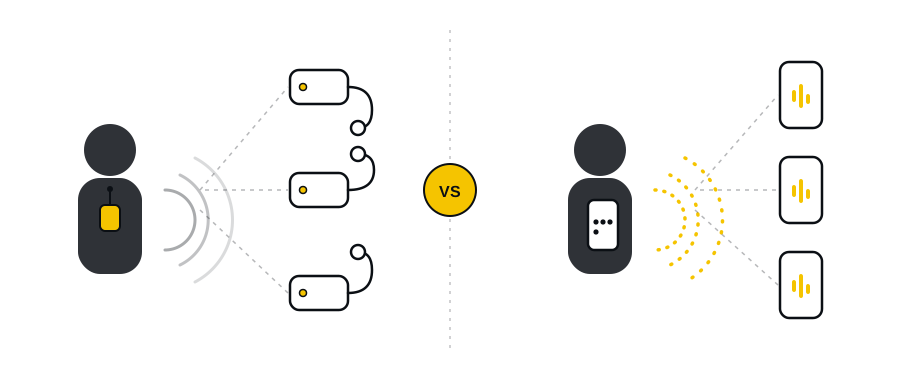
A tour guide radio system is a small audio transmission kit made up of:
- a transmitter with a microphone, worn by the guide or speaker;
- a set of receivers with an earpiece, one per participant;
- a charging case to keep the receivers ready between uses.
Transmission typically runs over radio frequency (FM/VHF) or infrared, with a range from a few dozen to a few hundred metres depending on the model. It's mature technology, built to work without internet or mobile data — a real advantage in remote locations or venues with no connectivity at all.
How much do tour guide radio systems cost
Costs vary a lot depending on the number of receivers and the quality of the system, but as a rough guide:
- Daily rental: typically a per-person, per-day cost, which climbs for larger groups or when rental includes delivery and pickup on site.
- Buying a kit (transmitter + N receivers + charging case): an investment that only pays off with fairly regular use — otherwise the cost per use stays high.
- Hidden costs: replacing worn or lost earpieces, battery maintenance, and the time spent distributing and collecting units before and after every tour.
For occasional use, or for groups that change every day, these recurring costs — together with the operational time they demand — are often the heaviest line item, more than the rental fee itself.
The practical limits of tour guide radio systems
Beyond the cost, anyone using these systems daily knows the recurring friction points:
- Distribution and collection: before every tour, someone has to hand out a receiver to each participant, check it works, and collect them all at the end — with the risk of losses or forgotten units.
- Hygiene: earpieces pass from person to person; they need sanitising or disposable covers, which is an extra cost and an extra step.
- Battery management: receivers and transmitter need regular charging; a battery dying halfway through a tour is a problem that always shows up at the worst moment.
- Breakage and loss: electronics that pass through many hands break or go missing, and that cost adds up over time.
- Limited range: if the group spreads out or splits up, some receivers can drop out of the transmitter's range.
None of these problems is huge on its own, but together they turn managing a fleet of radio receivers into a small logistical job that repeats on every outing.
The alternative: smartphone audio apps
The idea behind apps like VoiceGuide AirLink is simple: almost every tour participant already has, in their pocket, a device perfectly capable of receiving real-time audio — their own smartphone. No extra hardware needed.
The typical flow looks like this:
- The guide opens the app and starts a new tour, getting a PIN.
- Each participant enters the PIN on their own smartphone and joins the tour within seconds.
- The guide speaks, and their voice reaches every connected guest in real time, through their own earphones or headphones.
With VoiceGuide AirLink specifically:
- No sign-up required, for the guide or for guests: everyone joins with just a PIN, protecting everyone's privacy.
- No devices to hand out or charge: every guest uses the smartphone and earphones they already own.
- Automatic reconnection: if a guest's connection (or the guide's) drops for a moment, the app reconnects on its own as soon as the signal comes back.
- Emergency hotspot: if a guest has no data connection, the guide can share their own as a hotspot.
- No range limit tied to radio frequency: what matters is the data connection, not physical distance from a transmitter.
The app keeps running in the background, so guides and guests can still use their phones for photos, messages, or anything else during the session without interrupting the audio.
Tour guide radios vs smartphone apps: a direct comparison
| Aspect | Radio systems | Smartphone app (e.g. VoiceGuide AirLink) |
|---|---|---|
| Hardware required | Transmitter + a receiver per guest | Just the smartphone everyone already has |
| Setup before the tour | Distributing and checking receivers | Share a PIN, everyone joins on their own |
| Battery management | Charging every receiver between uses | Each guest's own phone battery, as always |
| Earpiece hygiene | Shared or disposable earpieces | Every guest's own personal earphones |
| Works without internet | Yes, via radio frequency/infrared | No, needs at least a minimal data connection |
| Range | Limited by radio frequency (tens-hundreds of metres) | Tied to data connection, not physical distance |
| Cost for occasional use | Recurring rental or upfront kit purchase | A license sized to the guests and duration you need |
| Loss/breakage risk | Present on every receiver handed out | No extra device to lose or break |
When to choose which
Radio systems still make sense in a few specific contexts: places with no data coverage (some remote areas, underground sites, isolated archaeological sites) or very large events that need a dedicated system independent of the mobile network.
For most guided tours, tour operators, courses, meetings and events — i.e. contexts where the group has smartphones and at least a minimal data connection — an app like VoiceGuide AirLink removes most of the logistics: nothing to distribute, charge, sanitise, or collect at the end of the day. Just smartphones and a PIN.
How to get started
If you manage groups regularly and want to try, with no commitment, how much simpler your day can get once you drop the radio receivers, the fastest way is to test it on a real tour.
See how VoiceGuide AirLink works in detail, or request a free trial for your next tour.